
Uncategorized
Digital Art Afterschool Studio: An example of a Career Oriented Curriculum
Why does this matter in real life?

One of the chief complaints you hear from students is “How can I actually apply what I’m learning to the real world?” And while there is no helping Algebra in that department, there are a myriad of other subjects that can benefit from a dose of real world interaction. This is what the Digital Art Afterschool Studio is doing. It’s taking a cue from larger real world curriculum programs, such as Career Oriented Curriculum and focusing on digital artistry and community involvement.
What is Career Oriented Curriculum and how can it benefit students?
According to District Administration, a website focused on creative solutions for school districts: “A summer job for a 16-year-old typically involves serving coffee, scooping ice cream, or babysitting the neighborhood children. Some students at Miami-Dade County (Fla.) Public Schools, however, spent their summer vacation designing a children’s Web site for the city of Miami Beach. An increasing number of students are finding themselves mingling among professionals with internships in local businesses—the culmination of a work-based learning curriculum.” These real world experiences are invaluable to students as they do two things:
- Reality Check Experiences like this show the students the real life application for what they are learning.
- On the Job Experience Projects like the digital after school studio create professional connections that go beyond graduation and help move our students forward professionally.
One organization with a stellar track record in this area is the National Academy Foundation (NAF). Since 1982 they have worked tirelessly with teachers and schools to create and implement career-oriented curriculum. Schools that work with the NAF will frequently require an internship with a local business before allowing the student to graduate. According to NAF:
“Over 90 percent of NAF students graduate from high school, and four out of five students continue to college or postsecondary education. Of those students, 52 percent earn a bachelor’s degree.”
How do you do it?
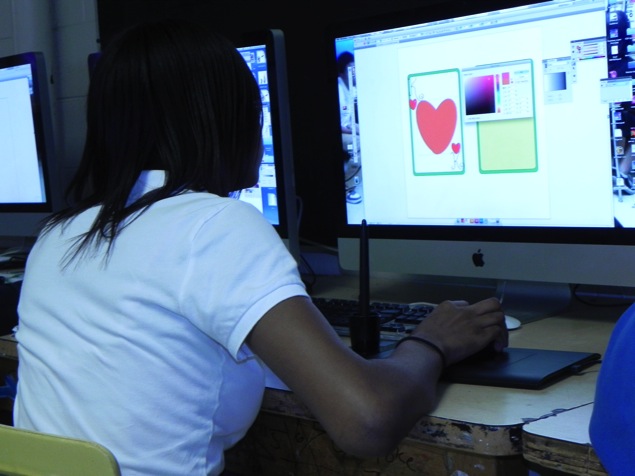
So how are the teachers and students at Overton High School, where the Digital Art Studio program has been in full swing for two years, applying the idea of career oriented curriculum to their specific needs?
According to their proposal “The after-school Digital Arts Studio program … enables students to build professional-level skills, as they develop their artistic portfolios. … The students will be introduced to client-based projects where they are expected to develop a working relationship with the client resulting in a marketable product.”
The program operates similar to a small graphic design studio. Taking place three times a week for two hours after school, students have the opportunity to really put work into a portfolio, and increase the possibility of scholarships and if a professional internship is tacked on, some AP credit. Projects are introduced from the needs of real world clients who the students and teachers reach out to. The projects can be anything from helping a local business create a print add to designing a website for a church event. This helps create crucial bridges between the school and the community around them, ultimately strengthening both.
This program has had to start small, accommodating only a few students at first. The principal and instructors consult with local ad agencies to create an interview process for students to simulate a job interview. The students selected work together to create a marketing campaign to alert the community to their presence and start soliciting clients. It is their hope that this model will, after a couple years, become self-sustaining.
What is the impact of a Career Oriented Curriculum?
So where are the students that have already passed through this program? Here are just a few of the success stories.
- Olivia Campbell, a second year participant, was awarded a full scholarship to attend University of Tennessee’s summer program for her Digital Art exhibited in the West Tennessee Regional Art competition last winter.
- Darion Beasley, King Hobson, and Maurico Farmer (all second year participants) were selected as three of the thirty-three students chosen to be represented in the Frist’s Museum’s exhibition Tennessee’s Top Young Artists.
- This year’s West Tennessee Regional Art Competition just released their awards and participants currently in the program won Best Graphic Design work, Best Photographic work, and placed in several other categories.
- One of the program’s participants, Cesar Pita, was just offered a $66,000 scholarship, the Presidential Scholarship, from Maryland Institute College of Art in Baltimore, one of the finest art colleges.
And these are just a few stories of success as this program continues to grow.
It’s clear from the work that NAF does and how Overton High School applies it to their own program that career-oriented curriculum puts students at a huge advantage over their peers that do not participate. By giving students an education grounded in reality, rather than existing in the abstract on the white board, we strengthen their chances of succeeding in the real world. Forging professional connections early on only increases the chance of future employment and education. By also giving students a personal stake in how their work is perceived by the community at large we give them the opportunity to push themselves to create something they can be proud of.
Learn More with these Related Links
- Career and Technical Education: Research
- Linking Learning to Life
- Career-Oriented Curriculum Delivers Critical Skills
- Proof is in: Career-oriented education works
Share this:

Holistic Approach to Writing in a Chicano Studies Class

The Bigger Picture on Holistic Writing
What is Holistic Writing?
So what is holistic writing and how can we apply it to our classrooms? Holistic writing is about mastering the art of looking at the big picture in its entirety before even putting pen to paper. It’s starting with the sum rather than the individual parts. Plot, characterization, grammar, cadence, all of these things are extremely important to learn individually; what’s more important is learning to use them in tandem. Even if every part is working fine on its own, if they don’t fit into the larger whole, the machine doesn’t work and the writing suffers for it.
By changing how we approach teaching writing, we can impact how students comprehend material.
How do you do it?
So what can educators do to integrate holistic writing in the classroom?
- Learn and foster a new writing process: This can include cross-genre analysis of texts, incorporating new media into their writing assignments, and fostering a collaborative writing process.
- Require all students to write extensively: By writing frequently and for many purposes, learners can be comfortable writing extended prose in elementary school and onward, setting them up for success in college. Schools can aid this process by making sure they hire excellent writing teachers as well as creating a curricula that fosters writing across all content areas at every grade level.
How can Holistic Writing be integrated in a Chicano Studies class?
Teachers at Valley High School a public school, with a predominately Latino population, were awarded a McCarthey Dressman grant to develop a Holistic Approach to Writing. This school is in a high poverty area where most students are English Language Learners and close to 90% of them receive free lunches. Valley High School Educators decided to address student gaps in literacy by taking the holistic writing approach and integrating it into their Chicano studies class.
The course is about the Chicano experience in relation to the following themes: history, identity, labor, gender and culture. While this course focuses on research and writing it takes a holistic method to teaching and learning. Students create murals, linoleum prints, and spoken word along with other forms of art. Each art piece is supported by research, a works cited page and thesis. Research skills are strengthened along with the student’s writing. In addition, students are required to construct a thesis surrounding their artwork, backed up with cited research. Instead of teaching writing and research separately, research lessons were taught throughout the year. Students were evaluated both on the artwork itself and the research that went into it.
What is the impact of Holistic Writing integration?
While initially it served eighty students, portions of the lessons bled over into history courses as the program moved forward. Over the three year project, they will reach 600 students and over 3,000 students will view their murals. Collaboration and teacher training has been a key factor in creating curriculum for this project. In the beginning of the project, it was necessary for the teachers to research the quality of papers at the college freshman level. Using what they learned, they developed a common rubric for the California High School Exit Examination (CAHSEE).
Their program has proved very effective. The Chicano studies instructor accomplished this by collaborating with the English instructor. He brought a sense of structure and form, while the English teacher helped the students understand style. According to the report, the students participating in this method have a 79% CASHEE passing rate, as opposed to the school’s average of 59%. The students have used a multi-disiplinary approach to Chicano studies including creating pieces of art (sugar skulls, day of the dead altars, murals painted with both acrylic and aerosol paints). When this method was later applied to the World History class in the second year of implementation they found the same thing happened, 79% vs 59%. The results speak for themselves.
If students are given the proper tools to excel, they will. The great thing about the holistic writing approach is that its reach far exceeds that of simple literary skills. It helps create a broader lens in which the student can view the world, their work, and ultimately themselves.
Learn more about Holistic Writing
Holistic Approach to Writing, Pt.1
Writing Now – pg. 4
THE WRITING PROCESS: – An Overview of Research on Teaching Writing
Share this:

Application now available
Applications are now being accepted on our website for this year’s application period (January 15 – April 15, 2013).
Please apply early as the number of applications which may be submitted is limited.
- 175 Academic Enrichment applications
- 75 Teacher Development applications
- 50 Scholarship applications
You can learn more about McCarthey Dressman Education Foundation’s 2012-2013 Grant Recipients here.
Here’s to another year of enriching and inspiring both learners and educators!

For more information, visit https://mccartheydressman.org/
Share this:


Integrated Studies: Placing Learning in the Real World
- How do visual arts, science and literature come together for student engagement and success?
 This month’s blog presents Valuing Place: A study of human impact on the American West an 8th grade integrated studies project that explores the impact of human activity on the American West’s ecosystems.

What is integrated studies?
Integrated studies connects two or more disciplines, showing ideas in context and giving students a more realistic view of how one works in the real world.
Teaching this way promotes:
- collaboration
- critical thinking
- an in-depth understanding of the areas being studied
For support developing an integrated studies approach visit the Edutopia website.
What can integrated studies look like for 8th grade students?
The project Valuing Place is a collaboration between science, humanities and visual arts teachers at the Salt Lake Arts Academy.

Through this project teachers have designed a cohesive curriculum that unifies the facts, skills, goals, and knowledge found within their core standards.
By designing a collaborative unit the teachers have created a powerful learning model for future integrated curriculum.
These powerful learning activities included standards-based connections to each content area:
- In the humanities, students read works of fiction and non-fiction, including primary sources about the settlement of the American West and Utah.
- In science, the standards addressed the theme of “change” and students were asked to analyze the influence humans have had on the environment. Students studied the geological forces that created the geography of the American West and its natural resources and eco-systems. Through experiments and fieldwork students studied how human activity, along the Wasatch front, positively or negatively impacted the local eco-systems.
- In visual arts, students were taught photography, basic drawing and watercolor techniques. Additionally they analyzed old photographs and artwork of the American West and Utah.

Students created original products that showed a deep understanding of the complex issues as a result of western expansion and how those issues remain relevant to the present as well as to the future way of life for Utah.
The Valuing Place project helped students demonstrate:
- increased proficiency in narrative, expository and informational writing
- targeted visual arts techniques
- multiple perspectives about how human activity has impacted their local eco-systems over time.

During Year One of McCarthey Dressman funding, students looked into the changes in the past 150 years to the Wasatch front, and the impact of mining on local eco-systems.
In Year Two of the project, the students looked into the water and the impact of expanding development in the 20th century, the Central Utah Project and reliance on the Colorado River system.
In Year Three the issues and costs of future expansion, green building guidelines, alternative energy sources and conservation were studied.
What is the impact of integrated studies?

In closing, this is an excellent example of how education should work, now and in the future. Instead of learning in discreet, separate subjects, the disciplines are taught in a more integrated manner. Students are studying real problems, understanding the content at a deep level, working in teams and producing products they can be proud of and that are shared with a larger audience.
Next Month’s Topic
BOOM Magazine – an after school program that helps kids of all abilities, from extremely talented to inexperienced writers, express themselves, improve writing abilities, and gain confidence and life skills.
Share this:


- ← Previous
- 1
- 2
 McCarthey Dressman Education Foundation