
Technology
Future 2,000 Common Core emphasizes eBooks, improves curriculum
 Teachers and students need textbooks to be useful and relevant. With the release of the Next Generation Science Standards (NGSS) in 2013, the Science Department at Chapman High School in Chapman, Kansas, wanted to find a way to incorporate the NGSS as well as the Common Core Standards into classroom curriculum. In the process, they discovered that the textbooks they were currently using no longer met the needs of their students and classroom. In this update from Future 2,000 Common Core, you’ll hear about how educators used eBooks to meet curriculum goals for Physical Science, Biology, and Chemistry and improve understanding of standards while improving the students’ access to resources and increasing their motivation.
How does eBook creation improve curriculum?
Chapman High School science educators led by Sara Cook explained that starting with a blank canvas enabled them to “include the essential curriculum that students need to know rather than having them sifting through unnecessary material.” They planned to integrate multimedia, virtual labs, student work samples, projects, activities, and more. eBooks would allow their curriculum to come alive in ways that would engage students more than normal textbooks do. They focused on featuring student work to increase the expectation for projects over time. “They will make studying and teaching more effective,” Cook stated, “most importantly, we have the ability to revise and edit the books to best meet the needs of their students.”
According to project report, the goal was to create a book that met “the individual learning needs of their students, and better incorporates the Common Core Standards as well as the Next Generation Science Standards.”
An additional goal was to produce a textbook that the students would be able to access at anytime that could be easily updated with a changing curriculum. By saving a .pdf copy of the iBook and uploading the iBook to a website, the students could have access to the book on any web-based device.
How did educators evolve their curriculum with eBooks?
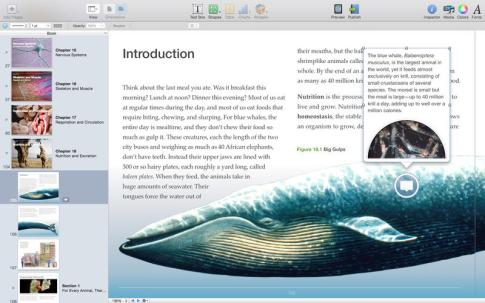
Participating educators started the project with a professional development day to learn how to use iBooks Author, a free software created by Apple for eBook creation on the Mac or iPad. Throughout the year they scheduled 4 other professional development days to work on eBook creation. During the school year, they collected student work to be featured in the book for the next group of students. Sara Cook published the eBooks online for all students to access and to share the project progress, you can view them at:
[https://sites.google.com/a/chapmanirish.net/scook/mccarthey-grant]
Below are some screenshots from a few of the eBook offerings created by Future 2,000 Common Core.
What did they discover?
All of the iBooks, except one, were used with students over the course of the year. The students are enjoyed viewing and using the books on the iPad and Computers. Students liked having access to the book at home especially when they were absent from class. Also, students loved competing to become “published.” They seemed to be excited about their work being used as an example for future classes.
As far as teaching, the creation of the eBooks allowed the department time to become more familiar with both the NGSS and Common Core standards. They were able to find better videos, animations, labs, websites and other resources to meet the needs of the new standards. Cook stated, “We personally feel like we have a better understanding of strengths and weaknesses of our curriculum than we did last year at this time. Since our iBooks are Standards Based, this has also allowed us to start discussing the possibility of integrating Standards Based Grading into our Curriculum. This would allow us to better see what our students know and don’t know in relation to the NGSS. Most importantly, this grant has provided us with time to collaborate and develop content that can be used in our classroom, which directly benefits our students.”
What advice would they give to others?
The biggest challenge for this team was the time that it takes to complete the eBook. It was their hope that they would complete more curriculum during the first year of the project. After the first work session, they quickly realized this process would take many more hours than initially expected. eBook creation is a time-consuming process to obtain content and find media appropriate to make the books as interactive as possible. However, they do feel that the time they are spending is well justified if it helps them meet the needs of their students.
One area of improvement for next year will be to come to the work sessions with all content, pictures and other resources already saved into files on the computer and ready to place into the book. This would allow more time to be spent on implementation & editing instead of gathering content. They plan to continue with work sessions during the summer and through next school year.
From a budget perspective, the project team learned that there were subscriptions for interactive simulations and labs that they wanted to incorporate into the eBooks. They decided to consider that as an important item in the next year’s grant budget, as the funding was not available from their institution.
Resources
If you would like to useeBook creation as a way of improving your curriculum, we recommend the following resources.
- Build Your Own Textbook (Audrey Watters, Edutopia, 2011)
- How to Create Your Own Textbook With or Without Apple (KQED Mindshift, 2012)
- CK12 Standards Aligned Flexbooks (CK-12 Foundation, 2016)
- Students as eBook Authors (The Creative Educator, 2014)
- NeBooks Teacher Resource Center (Nebraska Department of Education)
- Reading and Teaching with eBooks (EdTechTeacher)
Share this:

Real World Relevance Builds Career Skills at Digital Art Afterschool Studio
Where can students spend time after school honing career skills and building a portfolio?
Miami-Dade County (Fla.) Public Schools’ career-oriented program Digital Art Afterschool Studio offers students exactly that.
Last year, one of the biggest themes in the projects we funded was real world relevance. Students are often bored with classes that they can’t see themselves using in the real world. Tactile skill based courses such as Art and Music have limited career prospects when compared to STEM courses. The Digital Art After School Studio is a prime example of how to synthesize real world skills and arts education in a way that profits both the school and the students. Over the past three years they have turned from a tiny operation that struggled to find funding to a nearly self-sufficient model that will continue for years to come.
To recap, what is the Digital Art After School Studio?
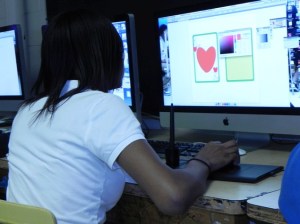
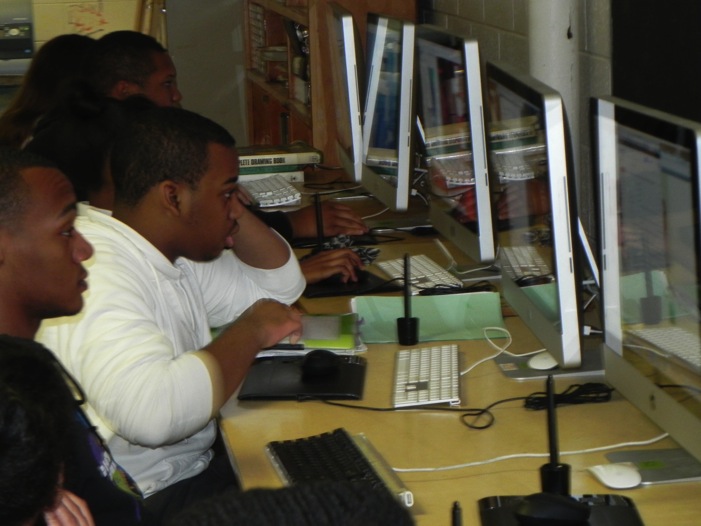
The Digital Art After School Studio program was created with the idea of giving students with an interest in graphic design a place to learn the procedures and expectations of actual client-based projects. The initial goals were to give students exposure to a workplace environment and ideally an increased level of workplace etiquette and knowledge of practices. The other, more long-term goal for the program was to get students more in touch with the community in order to build a client base that will continue to support the program long after the grant funding ends.
According to their project report
“Once establishing these relationships, the students were expected to maintain contact with the client. This follow-up was intended to build community ties that would emphasize the relationship the school had within the community, as well as introduce the students as individuals of worth to the adults in the community who were involved in running small businesses.”
Where are they now?
First and foremost, the most unexpected and fantastic occurrence has been the increased student involvement and ownership of the program. Word of mouth has gotten so strong that they no longer need to recruit to replace graduating members. They have students lining up to put their name on the list. The students this past year even took their ownership of the program so far as to elect to rebrand it the “Painttank,” a think tank for artists. During the past year they’ve had numerous visitations from other schools that are interested in emulating their model. They see students voluntarily giving up their afternoon freedom to work on their own projects and wonder how they can reproduce this in their own schools. The answer is simple. By cultivating an atmosphere of independence and freedom to explore their individual styles, the students become personally invested in their own work and growth as artists. Not only that, it’s completely student driven in the hours after school, acting autonomously and driving its own progress forward.
One of the biggest victories the school has achieved is the founding of the Overton Foundation, a non-profit entity that allows for donations to be made without getting caught up in the bureaucracy of the school district. In previous years, it was difficult to distribute funds from those wanting to pay for the studio’s services.

“With this new entity we will now be able to create a cash flow that revolves around the work produced and reward those students involved with direct, over-the-board, payments. This will provide the opportunity for students to learn to keep a job budget and understand pricing. It also allows for our studio to bid on jobs, and provide invoices for those we complete.”
The Overton Foundation is key to the future self-sustainability of this project.
In terms of improvement, the program is always on the hunt for new clients. Most of the initial client base came from sources directly related to the student and school, but now with multiple accolades under their belts and a sizable portfolio, the Studio is looking to expand further into the community. With the hurdles of creating the Overton Foundation and the initial cost of computers and software suites out of the way, it’s really up to the students and their mentors to guide this program into the future.
And it’s looking like a bright one.
Gallery of Afterschool Studio Artwork
Further reading on Real World Enrichment
- Co-op Programs Becoming Popular for Real World
- The Great Debate – Education vs. Experience
- Real World Experiences
Learn More about Career-Oriented Curriculum
- Career and Technical Education: Research
- Linking Learning to Life
- Career-Oriented Curriculum Delivers Critical Skills
- Proof is in: Career-oriented education works
Share this:

CFCO: Service Learning Builds 21st Century Skills, Engages Teens
Connecting lessons learned in classrooms to real world applications is one of the great challenges in teaching. Teachers and administrators at Harrison High School in Evansville, Indiana have come up with an innovative new classroom model to address that challenge.
What is the CFCO?
They have created the Center for Family and Community Outreach (CFCO), which aims to use student skills (built around academic content) to create documents, multimedia, events, presentations, and more for over twenty non-profit organizations in their community.
Educators are able to connect students with members of the non-profit community, creating a symbiotic relationship wherein the student gains valuable real-life skills and the non-profits get a free service. Not only is it easier to engage teenage minds directly if they feel a sense of involvement and contribution towards the betterment of their community, it also helps teens build invaluable skills for the transition into their adult lives.
How can service learning support non-profits and drive engagement for learners?
There are many service learning projects around the country, but few, if any, that drives content in the classroom around producing products for non-profits. The CFCO model has elements of numerous trends in education, such as:

- project-based learning
- student-centered learning
- and new technology,
but is truly innovative for the level of engagement it produces for students.
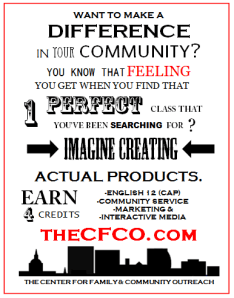
This program has seven distinct goals.
- Research the non-profit groups and social issues in students’ communities.
- Hold ‘Round Table’ discussions with local experts on special topic issues using the latest online literature and information.
- Tour the non-profit facilities and volunteer with local organizations and events.
- Collaborate with leaders on project ideas and write formal proposals
- Use project based learning and technology to design and create materials
- “Pitch” their ideas through benchmarks and final presentations
- Openly communicate with the community through blogging and video reflections.
Importance of Community Support
Students are immersed in the tangible application of skills from the classroom, and since students know what they are doing will have a real impact on their community, it is readily apparent how seriously they take it. The program has relied on a tremendous amount of community support and is currently in it’s third year of operation. Fortunately they continue to draw in new non-profit partners based on the satisfaction of their initial partners and publicity the projects have generated for the mission of non-profits in Evansville.
What is the impact?
So where are the teachers and students of Harrison High School now, a year into the program? Reports have come back with very positive results, including:
- Students have a sense of ownership and engagement in their work as well as their community.
- Non-profit data shows that the community’s organizations have much higher perception of the schools and teens’ abilities after working with the CFCO.
Moving forward they plan on moving the program to a half day model, to increase student exposure, as well as continuing to nurture community involvement and contribution.

With such an easily adaptable model, educators around the country should be looking to Evansville, and Harrison High School in particular. How they proceed could very well dictate how dozens of similar programs pop up in the future. Community involvement and concrete links between lessons learned in the classroom and real world applications are key in both advancing education as well as building a student body that is invested in the present and future of their community. While the saying “It takes a village to raise a child,” has been politicized as of late, I think we can all agree that fostering a child’s investment and involvement in his or her village can only lead to positive results.
For more information
Related articles
- NSSE Results 2013 (teachingresearcher.wordpress.com)
- Creating Space for Marginalized Voices: Re-focusing Service Learning on Community Change and Social Justice (knrajlibrary.wordpress.com)
- Online Student is Set on ReStore-ing Ethics (blogs.msbcollege.edu)
Share this:

Microfinance in Action
How can high school students learn about globalization in an economics course?
In an increasingly globalized world the standard skill set of a global citizen is rapidly shifting. While it would be impossible to give the students every bit of skill and knowledge they will need to be competitive in the global marketplace, one program is setting about to make a small change in how high school students approach economics that looks to be paying big dividends.

The teachers at Southwind High School in Memphis, TN have implemented a completely unique approach to teaching economics students about globalization and microfinance.
The project, currently in progress, involves the students in project-based learning to address multiple student skills including:
- critical thinking
- decision-making
- global citizenship, and
- responsibility
So how has this school approached this project and how successful have they been in its implementation? This ambitious endeavor is projected to take three years to implement.
Incorporating Problem Based Learning with Global Economic Issues
For economics students at Southwind High, things have changed. No longer the victims of textbooks and lectures, these students participate in an integrated curriculum on globalization.
What does an integrated curriculum exploring globalization and economics look like?
First, students work in groups to develop awareness of important concepts for the project. Research topics include:

- United Nations’ Millennium Development Goals (MDGs)
- economic, political, and social issues of a particular developing nation
- use of microfinance to promote economic growth and sustainability
Next, using ‘future problem solving’ skills, the groups develop a solution to address those issues in their selected country.
Finally, students will present their findings to the Ambassador of their selected country. Presentations will also be shared in a guidebook entitled Microfinance in Action: A Guide for Teenagers that will be used to supplement other high school economics courses.
How are real world skills and field experiences incorporated into the project?
In addition to the web research conducted, student groups communicate via Skype to high schools in developing nations. Using social media, students promote awareness of global economic issues, publishing research to a global awareness blog and producing video documentary segments. The blog also invites other schools to get involved or start their own program.
Students also have the opportunity to travel to various locations in the United States and Central America to document individual stories of those most affected by economic issues. During that time students will produce presentations on research they have conducted on economic, political, and cultural issues on selected developing nations.
What is the impact of this project so far?
During year one, students created the project website where you can watch the project unfold. (http://shskivamemphis.weebly.com). Groups have completed their Global research and the first two chapters of the Guidebook have been drafted and are being revised. The students and participating faculty traveled both to the Global Youth Institute as well as to Mississippi to film their documentary projects. So far, the program served 150 students at Southwind as well as teachers from ten different schools.
How can this project inspire other educators?
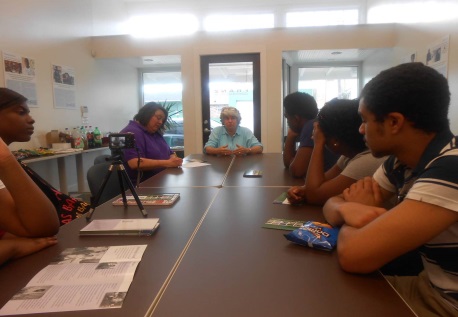
By taking such a unique and global perspective on economics, teachers Biba S. Kavass and Landon Hawthorne are insuring their students will have a much easier time navigating the global market place due to the early exposure to real economic disparity issues and their subsequent research and involvement.
Project-based learning and integrated curriculum are powerful opportunities to engage students and build real world skills. Here are some resources to explore for developing similar projects for your students.
- Future Problem Solving Skills Program
- KivaU
- OneHen
- Integrating Globalization into the Curriculum
- Three Ideas for a 21st Century Global Currlculum
- Teaching Global
- New York Times Learning Network: Globalization
Related articles
- Pbl (pcreadingposts.wordpress.com)
- The Joy of Project Based Learning (nsparks89.wordpress.com)
- Project Based Learning in a 1:1 School (karenmcvay.com)
- The PBL Super Highway… Over 45 Links To Great Project Based Learning (21centuryedtech.wordpress.com)
Share this:

- ← Previous
- 1
- 2
 McCarthey Dressman Education Foundation